Vibe Coding Done Right: Why AI Tools Are Only as Good as the Operator
"Vibe Coding" is Collins Dictionary's 2025 Word of the Year. So is "AI Slop." The difference between the two comes down to one thing: the human behind the keyboard.
The Year AI Changed How We Write Code
In early 2025, Andrej Karpathy described a new way of programming: "fully giving in to the vibes, embracing exponentials, and forgetting that the code even exists."
He called it Vibe Coding.
Within months, the term exploded. Collins Dictionary named it their 2025 Word of the Year. Y Combinator reported that 25% of their Winter 2025 batch had codebases that were 95% AI-generated. Major tech companies announced that 30-50% of their new code now comes from AI assistants.
But here's the uncomfortable truth that often gets buried in the hype: Merriam-Webster and Macquarie Dictionary chose a different word for 2025—AI Slop, defined as "low-quality content created by generative AI, often containing errors."
These two words of the year aren't contradictory. They're two sides of the same coin.
The Problem Isn't AI. It's How We Use It.
A Veracode study in 2025 found that 45% of AI-generated code introduces security vulnerabilities. AI models hallucinate non-existent packages 5-21% of the time—a vulnerability attackers now exploit through "slopsquatting."
Meanwhile, a rigorous METR study tracked experienced developers and found something counterintuitive: developers using AI tools experienced a 19% decrease in productivity compared to working without AI. Yet those same developers estimated AI had increased their productivity by 20%.
A 39-point gap between perception and reality.
This isn't an indictment of AI coding tools. It's a wake-up call about how we're using them.
The teams producing AI slop and the teams shipping production-quality software are often using the exact same tools. The difference isn't the technology—it's the methodology.
AI Coding Tools Are Just Tools
Whether you call it Vibe Coding, AI Coding, or AI-assisted development, the fundamental truth remains: these are tools, and tools require skilled operators.
A chainsaw in the hands of a master carpenter creates furniture. In untrained hands, it creates disasters.
AI coding tools amplify whatever approach you bring to them:
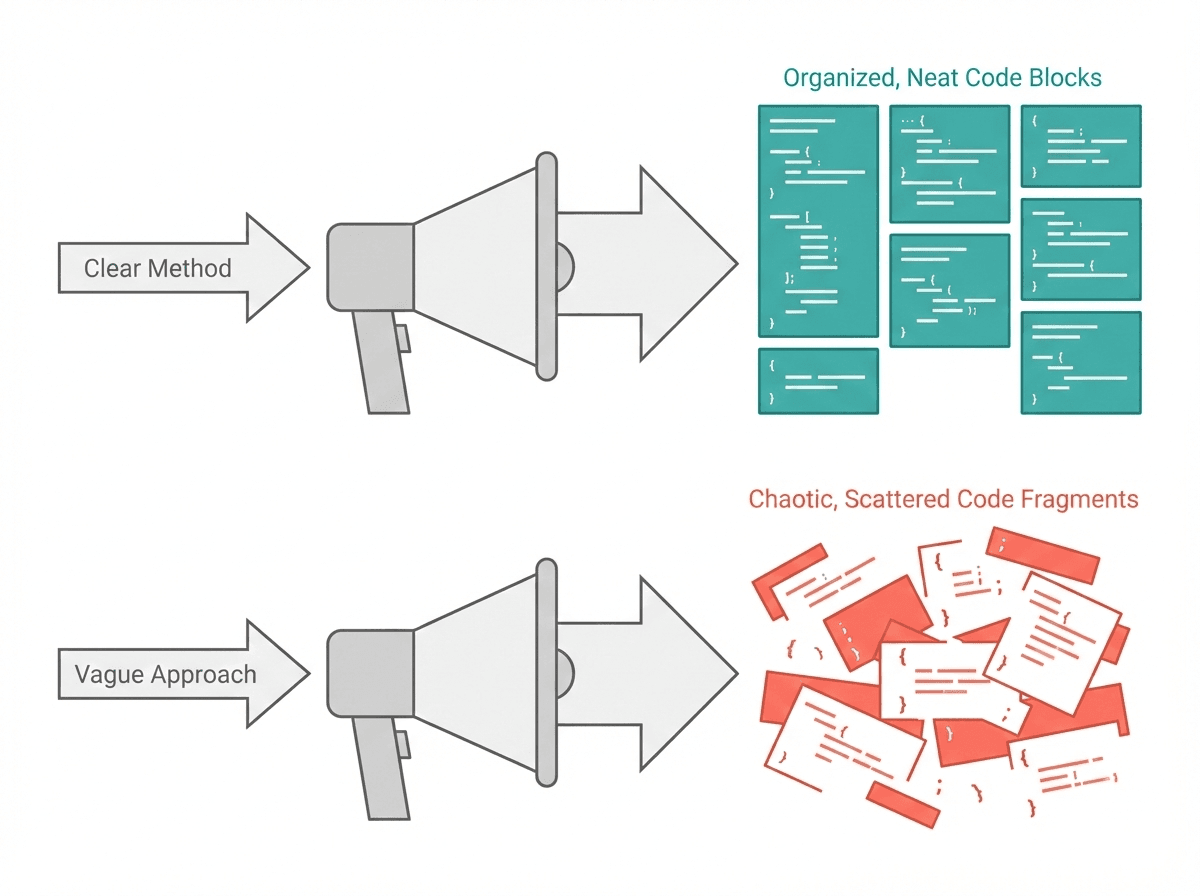
- Clear problem definition → focused, useful code
- Vague prompts → generic, often broken implementations
- Strong architectural vision → coherent systems
- No technical judgment → spaghetti that happens to compile
The qualities that matter haven't changed:
- A clear pain point you're solving
- Product development expertise to know what "good" looks like
- Quality standards you refuse to compromise
- The discipline to review, test, and iterate
Without these, you're not building products. You're generating slop.
What We Learned Using AI Coding in Production
Our team at JidouAI has been building with AI coding tools extensively. We've compared different tools, experimented with workflows, and made plenty of mistakes along the way.
Here's what we discovered:
The Code Review Bottleneck
When developers started shipping code faster with AI assistance, a new problem emerged: code review became the bottleneck.
The volume of code to review increased dramatically. Reviewers couldn't keep up. And AI-generated code has a particular challenge—it often looks correct but contains subtle issues that require careful attention to catch.
Our Evolution
We went through several phases:
Phase 1: Excitement Everyone using AI tools individually. Fast output. Growing technical debt.
Phase 2: Problems Surface Code review backlogs. Inconsistent patterns. Bugs in production that looked right in review.
Phase 3: Process Refinement We introduced AI-assisted code review tools. We established spec-driven development practices. We standardized on tools that fit our workflow.
Phase 4: Sustainable Velocity AI coding became integral to our process—but within a structured framework that maintained quality.
The Key Insight
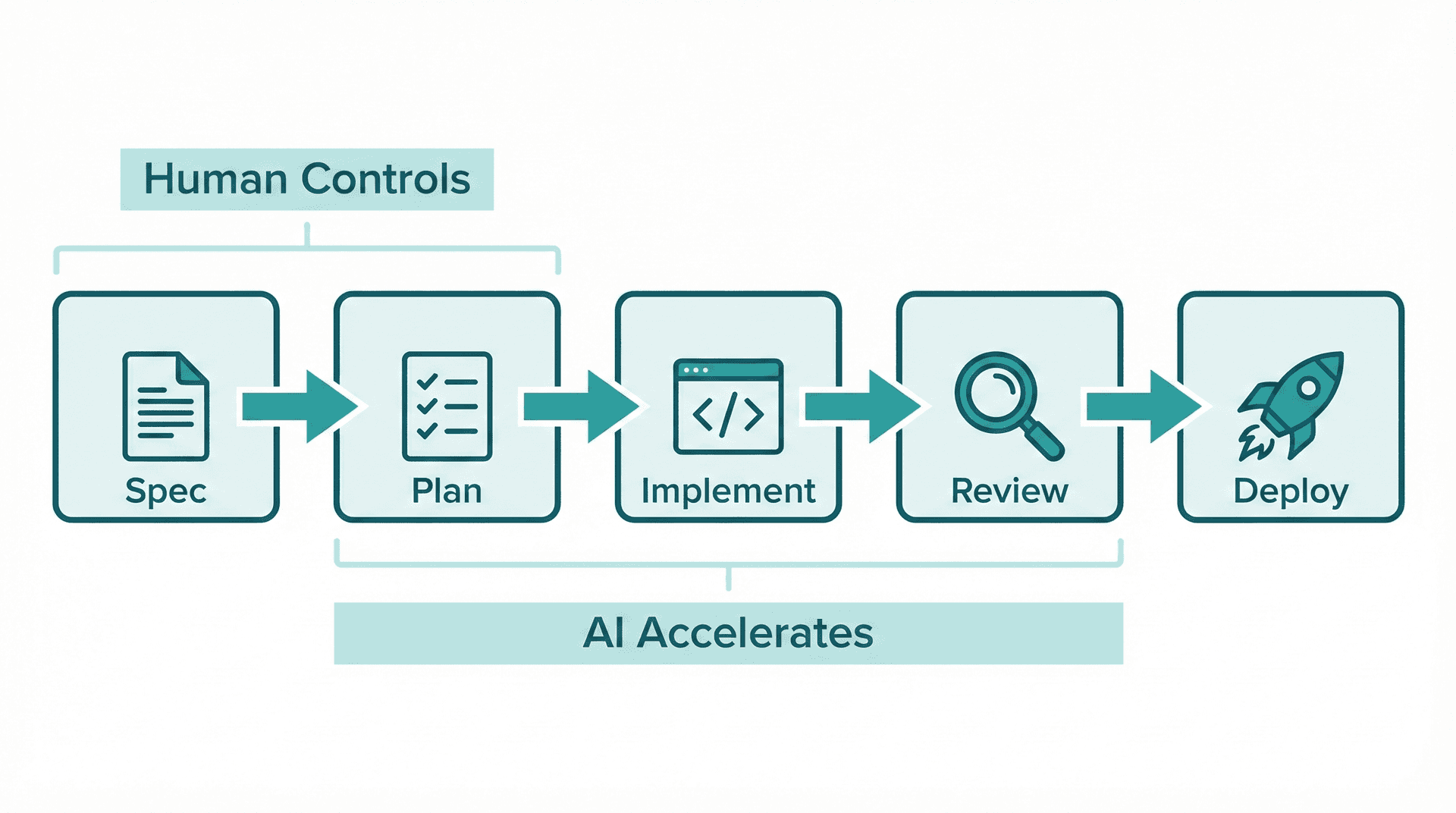
The breakthrough wasn't finding the "best" AI tool. It was establishing spec-driven development as our foundation.
Before any AI writes a line of code, we have:
- Complete specification documents
- Clear acceptance criteria
- Defined architectural constraints
- Test requirements
The human controls the what and why. AI handles more of the how—implementation, unit tests, boilerplate. But humans review everything.
The result: we shipped Heimin from concept to internal POC in 2 days, and to production in 30 days—without compromising code quality.
Comparing AI Coding Tools: What Actually Matters
The market is crowded: Cursor, Claude Code, GitHub Copilot, Windsurf, Google's Antigravity, OpenAI Codex. Every week brings new comparisons and benchmarks.
After extensive evaluation, here's our take on what actually matters:
The Major Players
| Tool | Approach | Best For |
|---|---|---|
| Cursor | VS Code fork with deep AI integration | Developers wanting GUI + multi-file editing |
| Claude Code | Terminal, VS Code, and web — all supported | Flexible developers, complex codebases |
| GitHub Copilot | Extension-based, broad IDE support | Teams already in GitHub ecosystem |
| Windsurf | VS Code fork, agent-focused | Beginners, cleaner UI preference |
| Antigravity | VS Code fork, supports Gemini + Anthropic models, agent-focused | Google ecosystem users, multi-model flexibility |
| Codex | API-focused, enterprise | Large-scale automation |
Our Choice: Claude Code + Custom Plugins
After comparing these tools, our team consistently found that Claude Code, combined with specialized plugins, delivered the best balance of speed and quality for our workflow.
The key plugins that make the difference:
- feature-dev: Structured feature development workflow
- frontend-design: UI/component generation with design system awareness
- code-refactor (our custom plugin): Systematic refactoring with quality checks
Why Claude Code specifically?
The terminal-first approach forces intentionality. You can't just accept autocomplete suggestions mindlessly—you're having a conversation about what you want to build. Combined with plugins that encode your team's best practices, it becomes a genuine force multiplier rather than a source of technical debt.
That said, the "best" tool depends entirely on your team's workflow, codebase, and preferences. The tool matters far less than the methodology you wrap around it.
The Rise of Spec-Driven Development
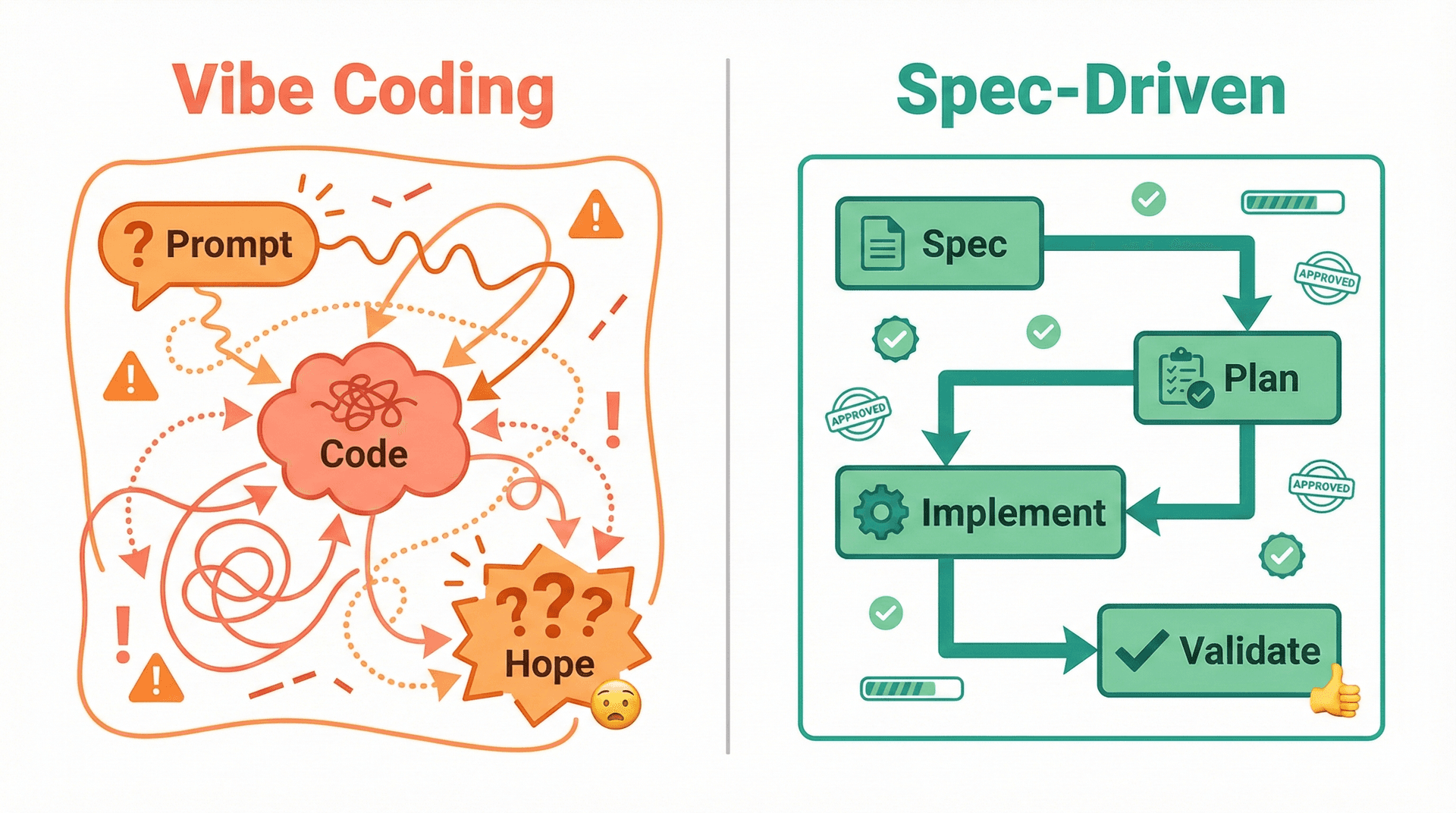
If Vibe Coding was 2024's excitement, Spec-Driven Development is 2025's correction.
GitHub released Spec Kit. AWS launched Kiro with explicit "Spec Mode." JetBrains, Anthropic, and others are all emphasizing the same insight: specifications help AI just as they help humans.
The pattern emerging across the industry:
- Vibe coding for rapid prototyping and exploration
- Spec-driven development for production code
As Sean Grove from OpenAI put it: "The person who communicates the best will be the most valuable programmer in the future. The new scarce skill is writing specifications that fully capture your intent."
The irony? This isn't new. It's a return to software engineering fundamentals—design before implementation—but adapted for the agentic AI era.
The Closed Loop: Building Heimin with Heimin
Here's where it gets interesting.
Heimin is a task management tool. We built Heimin using AI coding workflows. And we manage Heimin's development tasks... in Heimin.
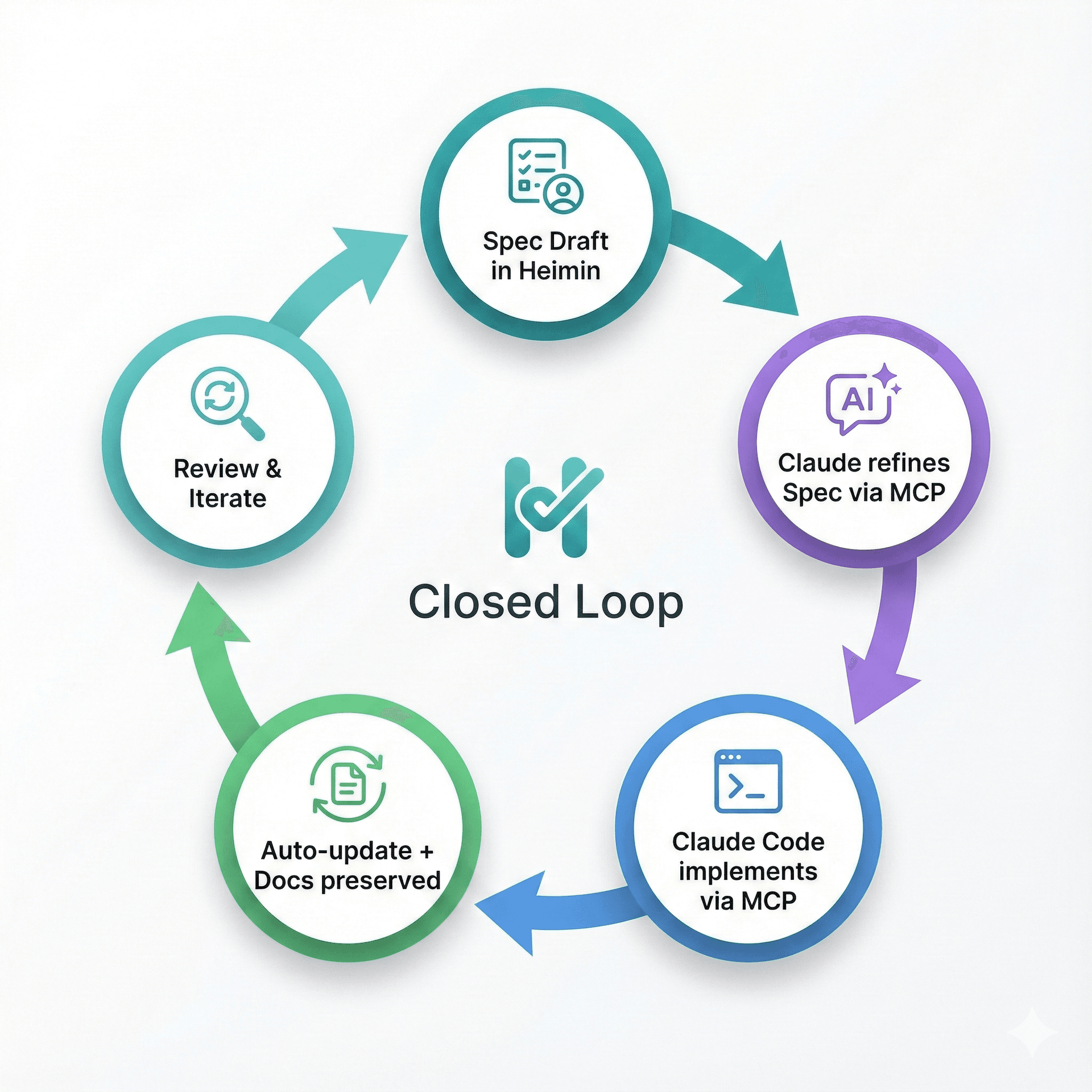
This creates what we call a closed-loop development cycle:
- Specifications live in Heimin as detailed task descriptions—humans draft the initial spec
- Claude (chat) reads tasks via MCP to understand context, then helps refine and optimize the spec through AI collaboration
- Claude Code reads tasks via MCP and executes implementation based on the refined specifications
- Progress updates flow back to Heimin automatically, with complete documentation preserved
- Review and iteration happens within the same system
The tool we're building is the tool we use to build it.
This isn't just dogfooding. It's a fundamentally different relationship between product management and development. When your AI coding assistant can directly access your task management system, the friction between "what needs to be built" and "what gets built" approaches zero.
MCP: The Missing Link
Model Context Protocol (MCP) is what makes this possible. It allows Claude and Claude Code to:
- Pull task details and specifications directly
- Understand project context without manual copying
- Update task status as work progresses
- Maintain continuity across development sessions
The result is AI that doesn't just write code—it participates in the full development workflow.
Practical Takeaways
If you're adopting AI coding tools, here's what actually works:
Do This
✅ Establish specs before prompting. The clearer your intent, the better the output.
✅ Invest in code review. AI-generated code needs more review, not less. Consider AI-assisted review tools to keep pace.
✅ Choose tools that fit your workflow. The "best" tool is the one your team will actually use correctly.
✅ Treat AI as a junior developer. Fast, capable, but needs clear direction and supervision.
✅ Build feedback loops. Track what works. Adjust your prompts and processes based on results.
Avoid This
❌ Don't accept code you don't understand. If you can't explain it, you can't maintain it.
❌ Don't skip testing because "AI wrote it." AI-generated code has higher vulnerability rates than human-written code.
❌ Don't confuse speed with productivity. Shipping fast then fixing for months isn't efficient.
❌ Don't let tooling drive architecture. Your technical judgment should guide the AI, not vice versa.
The Bottom Line
Vibe Coding isn't going away. AI-assisted development is becoming standard practice—76% of developers are now using or planning to use AI coding assistants.
But the gap between teams producing AI slop and teams shipping quality software is widening.
The difference isn't the tools. It's the operators.
Clear specifications. Strong review processes. Quality standards that don't bend. These fundamentals matter more in the AI era, not less.
The teams that will thrive aren't those who generate the most code. They're the ones who maintain the discipline to ensure that code is worth generating in the first place.
Heimin is the task management tool we built using these principles—and the tool we use to build it. Spec-driven development meets closed-loop execution. If your team values simplicity and quality, try Heimin free.
References
-
Collins Dictionary 2025 Word of the Year: "Vibe Coding" — The Conversation
-
Macquarie Dictionary 2025 Word of the Year: "AI Slop" — Phys.org
-
Veracode Study: 45% of AI-generated code introduces security vulnerabilities — Medium: The Rise of Vibe Coding
-
METR Study: 19% productivity decrease with AI tools — FinalRound AI
-
Y Combinator Winter 2025: 25% of batch with 95% AI-generated codebases — Medium: The Rise of Vibe Coding
-
Stack Overflow 2024 Developer Survey: 76% using or planning to use AI coding assistants — SoftwareSeni
-
Sean Grove (OpenAI) on specifications as the new programming skill — The New Stack
-
GitHub Spec Kit and Spec-Driven Development — GitHub Blog
-
AWS Kiro and Spec Mode — Kiro Blog
-
AI Coding Tools Comparison — Appwrite Blog, HumAI Blog